












News


13
July 2015
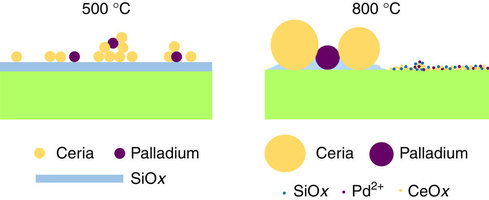
Published on Nature Communications the paper "Dynamic structural
evolution of supported palladium–ceria core–shell catalysts
revealed by in situ electron microscopy." by Shuyi
Zhang, Chen Chen, Matteo Cargnello, Paolo Fornasiero, Raymond J. Gorte,
George W. Graham and Xiaoqing Pan.
doi:10.1038/ncomms8778.






1
January 2015
Professor
Paolo Fornasiero is the Italian coordinator of Erasmus Mundus "Action
EurasiaCat"
"EurasiaCat: Advanced Education European-Asiatic Exchange Programme
in Materials Science and Catalysis" is an Erasmus Mundus Action-2
Strand-2 (EMA2/S2) project funded by the European Union. The aim of EURASICAT
is to offer multidisciplinary training in designing advanced functional
materials and catalytic processes. EURASIACAT is based on a partnership
composed of 11 universities (5 from Europe + 6 from Hong Kong / Taiwan
/ Singapore / Macau). In addition, CSIC, the Spanish Research Council,
acts as associated partner. The eleven universities that support this
consortium are of a very high academic level, and the academic key persons
involved are all well recognized in their respective fields of research.
The main objective of the project is offering scholarships/fellowships
at Master, Doctorate, Postdoc and Staff (Academic /Administrative) levels
(Undergraduate is NOT supported) to pursue study/research/teaching in
the fields of Materials Science and Chemical Engineering. Grantees will
receive cutting-edge education in all the research skills required for
the design of a catalytic process, being the main objective of EURASICAT
multidisciplinary team to rationally design functional materials and the
processes in which they are involved, which include: synthesis and characterization
of advanced nano-engineered materials, advanced spectroscopic characterization,
theoretical studies to uncover reaction/adsorption mechanisms and kinetics,
and process & reactor design.
Further information can be found at EurasiaCat website: https://sites.google.com/site/emeurasiacat/home




Professor Paolo Fornasiero will receive the Medaglia Chiusoli Award Sunday 15th September during the XVII National Congress of Catalysis GIC 2013 and XI National Congress of Zeolites Science and Technology (http://www.unibo.it/eventi/gic2013/programme). During the meeting he will deliver a lecture on “Tuning metal-support interactions in ceria based catalysts."

4
September 2013
Dr. Matteo Cargnello is the recipient of the 2013 PhD Award given by the
European Federation of Catalysis Societies EFCATS in recognition of an
outstanding PhD Thesis on catalysis. The award will be presented next
September during the XIth European
Congress on Catalysis in Lyon.
16 August 2013
Published
on SPublished
on Science the paper "Control of Metal Nanocrystal Size Reveals
Metal-Support Interface Role for Ceria Catalysts." by Matteo Cargnello,
Vicky Doan-Nguyen, Thomas R. Gordon, Rosa E. Diaz, Eric A. Stach, Raymond
J. Gorte, Paolo Fornasiero, and Christopher B. Murray.
Science
2013, 341, 771-773, doi:10.1126/science.1240148.
18 July 2013
Published
on Science Express the paper "Control of Metal Nanocrystal
Size Reveals Metal-Support Interface Role for Ceria Catalysts." by
Matteo Cargnello, Vicky Doan-Nguyen, Thomas R. Gordon, Rosa E. Diaz, Eric
A. Stach, Raymond J. Gorte, Paolo Fornasiero, and Christopher B. Murray.
doi:10.1126/science.1240148.

The Eni Award Scientific Commission selected Dr. Matteo Cargnello as one of the two "Debut in Research" 2013 ENI awards. The prestigious prize is awarded to researchers under 30 for their PhD thesis performed in Italian universities.
Dr. Matteo Cargnello obtained the PhD in Nanotecnology at the University of Trieste in our laboratories under the supervision of Professor Paolo Fornasiero.
His research focused on the synthesis of precise nanostructures as active, stable and multifunctional catalysts. He developed methods for preparing core-shell structures, with small metal particles embedded within a thin, porous oxide shell. These building blocks can be adsorbed on the surface of a wide range of supports, including oxides and carbon nanotubes, resulting in active and stable catalysts for the hydrogen production by photocatalysis, for the production of electricity in fuel cells and for controlling the emissions of methane.
The Eni Awards will be soon presented at the Quirinale in a ceremony attended by Italian President Giorgio Napolitano.

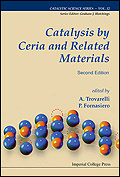
The Second Edition of the book "Catalysis by Ceria and Related Materials", edited by Alessandro Trovarelli and Paolo Fornasiero, is now available.
This book follows the 2002 edition of Catalysis by Ceria and Related Materials, which was the first book entirely devoted to ceria and its catalytic properties. In the ten years since the first edition a massive amount of work has been carried out in the field, and ceria has gained a prominent position in catalysis as one of the most valuable material for several applications. This second edition covers fundamental and applied aspects of the latest advances in ceria-based materials with a special focus on structural, redox and catalytic features. Special emphasis is given to nano-engineered and nano-shaped systems which are a key factor in the predictive and rational design of ceria with novel properties. In addition, the book presents recent advances in emerging and traditional large-scale applications of ceria in catalysis, such as the treatment of emissions from mobile sources (including diesel and gasoline engines).
1
January 2013
Prof. Paolo Fornasiero has been invited to join the Journal’s Editorial
Board Editors of ChemCatChem.